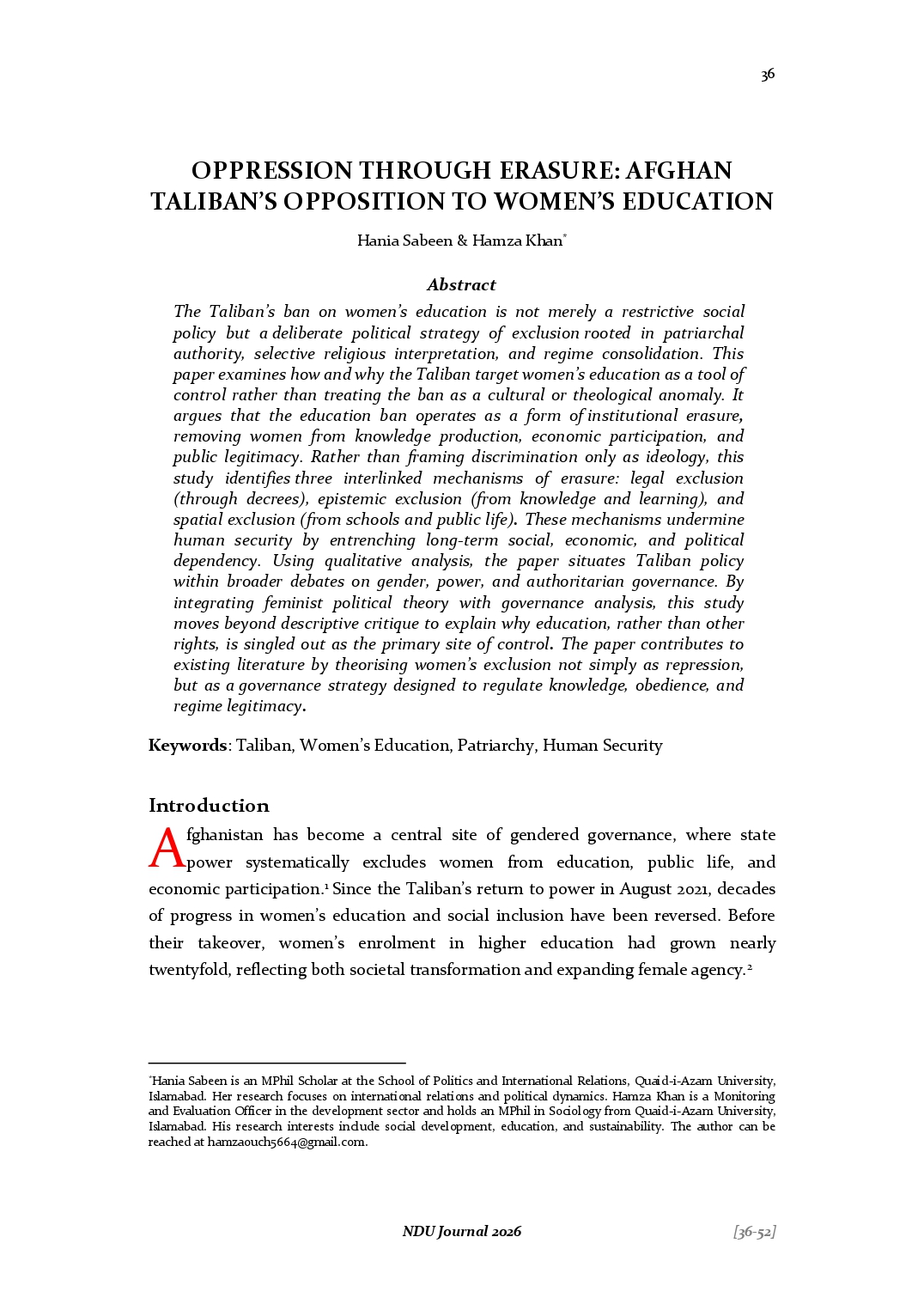
OPPRESSION THROUGH ERASURE: AFGHAN TALIBAN’S OPPOSITION TO WOMEN’S EDUCATION
DOI:
https://doi.org/10.54690/ndujournal.40.257Keywords:
Taliban, Women’s Education, Patriarchy, Human SecurityAbstract
The Taliban’s ban on women’s education is not merely a restrictive social policy but a deliberate political strategy of exclusion rooted in patriarchal authority, selective religious interpretation, and regime consolidation. This paper examines how and why the Taliban target women’s education as a tool of control rather than treating the ban as a cultural or theological anomaly. It argues that the education ban operates as a form of institutional erasure, removing women from knowledge production, economic participation, and public legitimacy. Rather than framing discrimination only as ideology, this study identifies three interlinked mechanisms of erasure: legal exclusion (through decrees), epistemic exclusion (from knowledge and learning), and spatial exclusion (from schools and public life). These mechanisms undermine human security by entrenching long-term social, economic, and political dependency. Using qualitative analysis, the paper situates Taliban policy within broader debates on gender, power, and authoritarian governance. By integrating feminist political theory with governance analysis, this study moves beyond descriptive critique to explain why education, rather than other rights, is singled out as the primary site of control. The paper contributes to existing literature by theorising women’s exclusion not simply as repression, but as a governance strategy designed to regulate knowledge, obedience, and regime legitimacy.
Downloads
Downloads
Published
Issue
Section
License

This work is licensed under a Creative Commons Attribution-NonCommercial 4.0 International License.