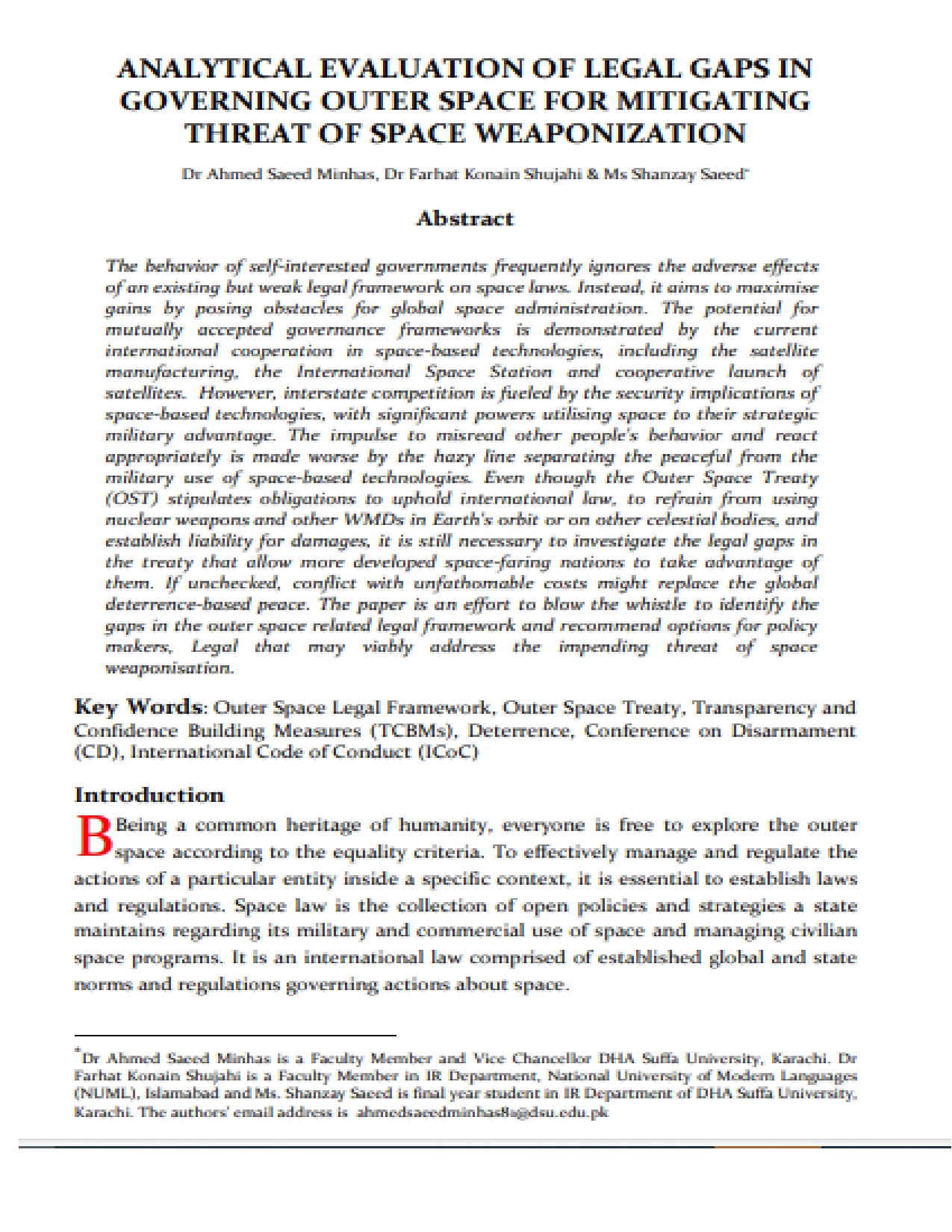
ANALYTICAL EVALUATION OF LEGAL GAPS IN GOVERNING OUTER SPACE FOR MITIGATING THREAT OF SPACE WEAPONIZATION
DOI:
https://doi.org/10.54690/ndujournal.39.231Keywords:
Outer Space Legal Framework, Outer Space Treaty, Transparency and Confidence Building Measures (TCBMs), Deterrence, Conference on Disarmament (CD), , International Code of Conduct (ICoC)Abstract
The behavior of self-interested governments frequently ignores the adverse effects of an existing but weak legal framework on space laws. Instead, it aims to maximise gains by posing obstacles for global space administration. The potential for mutually accepted governance frameworks is demonstrated by the current international cooperation in space-based technologies, including satellite
manufacturing, the International Space Station and cooperative launch of satellites. However, interstate competition is fueled by the security implications of space-based technologies, with significant powers utilising space to their strategic military advantage. The impulse to misread other people's behavior and react appropriately is made worse by the hazy line separating the peaceful from the
military use of space-based technologies. Even though the Outer Space Treaty (OST) stipulates obligations to uphold international law, to refrain from using nuclear weapons and other WMDs in Earth's orbit or on other celestial bodies, and establish liability for damages, it is still necessary to investigate the legal gaps in the treaty that allow more developed space-faring nations to take advantage of
them. If unchecked, conflict with unfathomable costs might replace the global deterrence-based peace. This paper is an effort to blow the whistle to identify the gaps in the outer space related legal framework and recommend options for policy makers, that may viably address the impending threat of space weaponisation.
Downloads
Downloads
Published
Issue
Section
License

This work is licensed under a Creative Commons Attribution-NonCommercial 4.0 International License.